
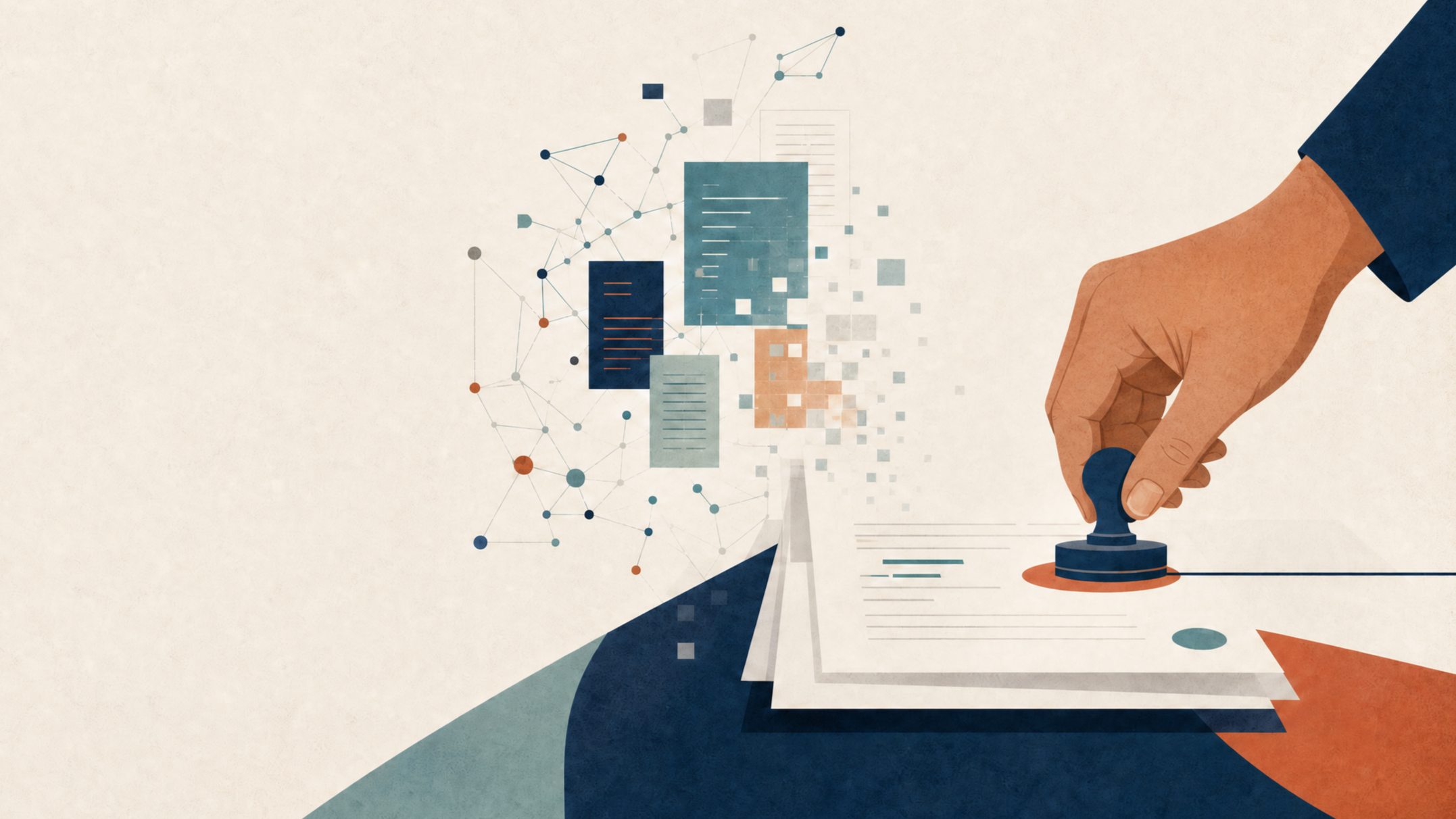
An Opinion on ‘Trust in the Age of AI’
Trust in this age is built on verifiability. On transparency. On the ability to stand behind a decision and say: "A human reviewed this. A human approved this. I am accountable for this."Trust is not built by AI being perfect. It's built by humans being accountable.
We live in an age where anyone can generate a perfect-looking report in three minutes. A client proposal that looks professionally designed. A legal analysis that sounds authoritative. An email that sounds like you.In this world, speed benefits, but where does 'Trust' sit?Trust can no longer be built the old way—through brand reputation, fast delivery, or clever campaigns alone. Those signals are easy to fake now. The competitive edge has shifted entirely. Trust in this age is built on verifiability. On transparency. On the ability to stand behind a decision and say: "A human reviewed this. A human approved this. I am accountable for this."Organizations that understand this are winning. Those that don't are accumulating trust debt—with customers, employees, regulators, and partners. And they don't even know it yet.Here’s an opinion on three dynamics reshaping trust in the age of AI:1. Trust Has Moved from Productivity to Verifiability
When every company can produce slick marketing materials in minutes, what separates trustworthy from trustless? The ability to show your work. To document decisions. To explain the reasoning—not just the outcome. A financial advisor who can show why they recommended an investment (with audit trail, disclosure, human review) wins over one who just produces a recommendation. A consulting firm that documents how AI assisted their analysis (with human sign-off) wins over one that hides it. A company that says "This draft was written by an AI and reviewed by a strategist" builds trust, not loses it.2. The Efficiency Paradox: Move Fast, But Move Together
Microsoft's 2026 Work Trend Index indicates that Malaysian employees are moving faster with AI than their organizations are prepared for. That's the trap. When people move fast alone, trust drops inside the team. Colleagues don't understand the tools being used, and managers may not see what's happening. Governance lags behind actual practice. Shadow AI becomes the default. The organizations winning aren't slowing down—they're synchronizing. "Move fast, but move together" is how you rebuild trust. The mechanism? Culture becomes your compliance system. When teams share clear norms about what tools they use, what they never put into an AI tool, and how they check each other's work—you don't need surveillance. You have shared accountability.That's the paradox: better governance makes teams faster, not slower.3. Accountability Cannot Be Outsourced
An AI cannot be fired. An AI cannot apologize. Only a person and a company can. Trust in the age of AI is a leadership decision, not a technology feature or a simple checkbox."Human-in-the-loop" is not a technical safeguard. It's a moral statement that says: "A human stands behind this, and when something goes wrong, there's someone you can hold accountable."If you can't name the person responsible for an AI decision, you don't have governance—you have deniability. And customers, partners, and regulators can sense the difference immediately.The question you need to think about
This is not a technology problem. You don't need a new tool to solve this. You need a decision. Specifically, someone in your organization needs to answer one question: "Who is accountable if an AI tool makes a mistake that harms a customer?"If you can't answer that clearly—if the answer is "the technology," or "we'll figure it out if it happens," or "nobody really"—you don't have trust architecture yet. The moment you can name a person and a process, the moment accountability becomes real, everything else becomes possible. Communication becomes easier. Governance becomes cultural. Teams move faster instead of slower. And trust happens.
Move Fast, But Move Together: Leadership in the Age of AI
AI is boosting productivity, but lasting advantage comes from leadership. How leaders can move fast and move together by pairing AI efficiency with people culture.
AI is boosting productivity, but lasting advantage comes from leadership. How leaders can move fast and move together by pairing AI efficiency with people culture.
In the past couple of weeks I've had conversations with University professors and senior business leaders about the relationship between AI and leadership. AI somewhat has this seductive story: deploy it and the automation and productivity gains will materialize. But what often gets left behind is a culture that goes hand-in-hand.The shift I'm seeing in how leaders think about this is telling.Leadership teams used to ask: "How do we get our team to use AI?"Now it's: "How do we lead well while our team uses AI?"That's not a semantic difference. That's a fundamental reorientation. The companies winning with AI aren't winning because they have better algorithms or bigger budgets. They're winning because their people have permission to imagine what's possible, safety to experiment, and clarity about why change matters. That's culture work. And it's work that starts in the boardroom. The Leadership Stakes Have Changed
Stanford GSB makes a powerful point when it stated that AI raises the stakes for leadership. While it can accelerate decision-making, it can also create a false sense of certainty. A leader armed with AI outputs but no cultural clarity is, dare I say, a leader making faster mistakes at scale.If your organization is already deploying AI without intentional culture work, you're not too late.Start with diagnosis, not deployment. Audit your current culture: Where do teams already experiment? Where do they resist change if it exists? Where do decision-making bottlenecks reside? The answers will point out where AI adoption would stall.Then, integrate cultural readiness into your AI roadmap. Run change management in parallel with technology rollout, not after. Redesign decision rights and incentives before teams have to navigate AI workflows. Build psychological safety explicitly, not by hoping it emerges.And tell the truth to your people. Not "AI will make everything better," but "AI will change how we work, and here's what that means for you, your role, and your growth."
Culture change is harder to communicate than capability demos. But it's also the difference between an AI implementation that works and one that sits in a folder gathering dust.So, leaders, take the time to clarify:Which tasks should be automatedWhere human judgment is requiredWho holds responsibility for outcomes
Leaders who move fast and move together aren't the ones who deployed AI first. They're the ones who asked: How do we lead well through this change? And then did the harder work of answering that question.If your organisation is moving fast with AI but you are sensing the team is not moving together, let us help you reset the balance.